Flat Earth Map: The concept of a Flat Earth Map has been a topic of interest and controversy among various communities around the world. According to the proponents of this theory, the Earth is not a spherical planet but rather a flat disc. The Flat Earth Map attempts to illustrate their beliefs by depicting the Earth as a flat surface, with the North Pole at the center and the continents spread outwards towards the edges.
Flat Earth Map
A Flat Map of Earth is a representation of our planet that diverges from the conventional understanding of Earth as a spherical object. Instead, it portrays the Earth as a flat surface, often resembling a disc or plane.
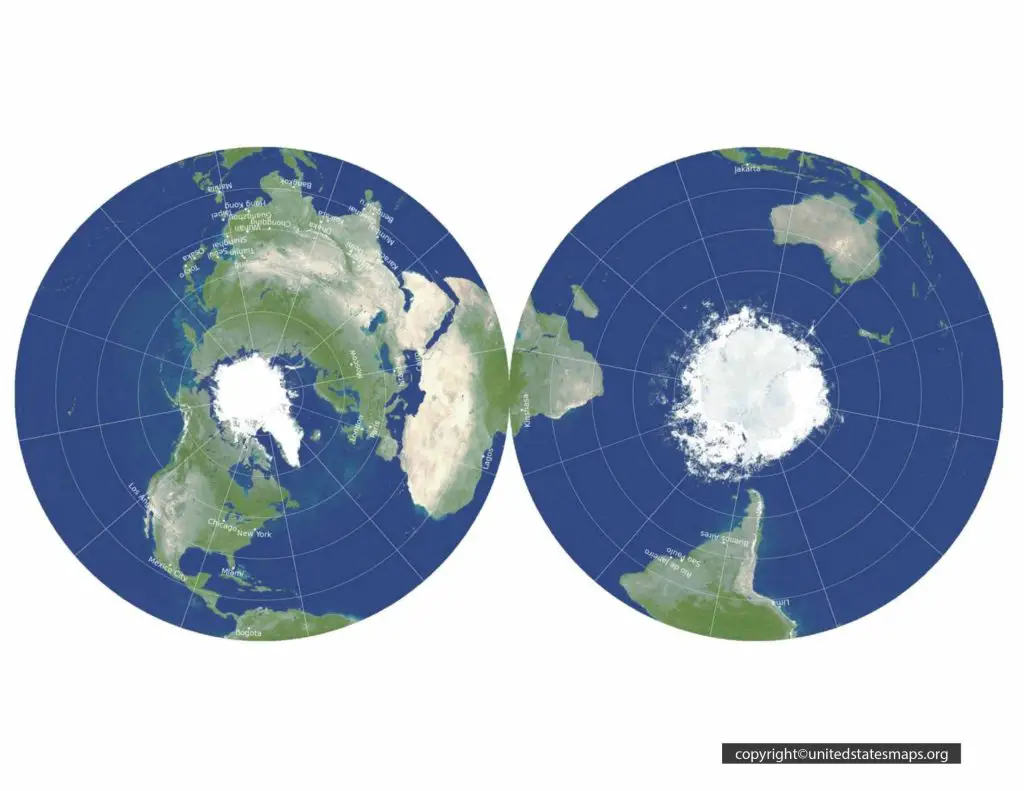
The Flat Earth theory has around since ancient Greece and gained popularity in the 19th century. It claims that the earth not a rotating sphere but a flat disk with the North Pole at its center and an ice wall surrounding it. Despite overwhelming scientific evidence to the contrary, this theory still persists today and has even gained traction on social media platforms.
Flat Earthers often use their own map of the world, which shows a circular disk divided into two hemispheres with Antarctica as an outer boundary. This map portrays continents as much larger than they in reality and distorts perspective. It also does not account for the curvature of the earth’s surface or explain phenomena such as gravity and seasons. Despite its lack of credibility, Flat Earth belief continues to spread online through various communities, podcasts, and YouTube channels.
One of the most commonly cited versions of the Flat Earth Map known as the “Azimuthal Equidistant Projection” or the “AE Map.” It portrays the Earth as a circular plane with the North Pole as the focal point. In this map, the equator depicted as a concentric circle around the edge of the disc, and the continents arranged in a way that they radiate outwards from the center. Check out other related maps:- Labeled World Map, High Resolution US Map.
Map of Flat Earth
A World Map Flat Earth is an alternative representation of the Earth that departs from the commonly accepted spherical model. Proponents of the Flat Earth Theory have created and circulated their versions of the World Map, which portrays the Earth as a flat disc or plane.
A Map of Flat Earth is a graphical representation that attempts to illustrate the concept of a flat Earth as believed by proponents of the Flat Earth Theory. Unlike traditional maps that depict the Earth as a spherical planet, a Flat Earth Map portrays the Earth as a flat disc or plane.
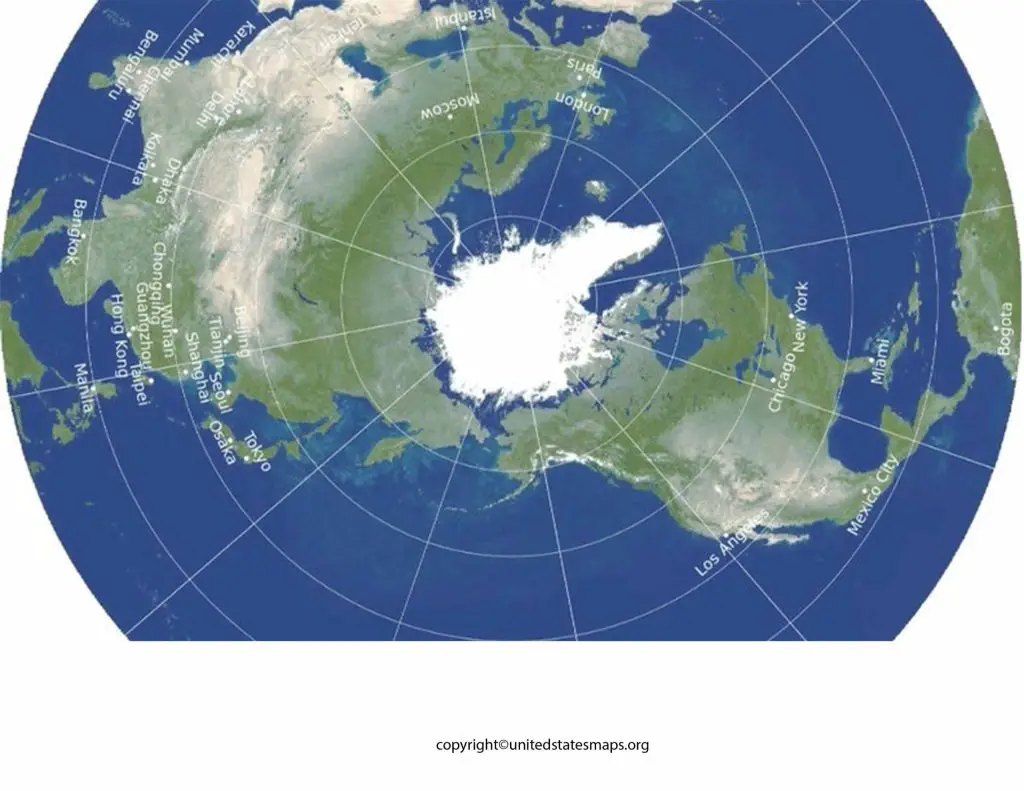
While there is no scientific basis for a flat Earth, some proponents of the Flat Earth Theory have created and circulated Flat Maps of Earth to align with their beliefs. These maps typically position the North Pole at the center and depict the continents spreading outwards towards the edges. They may also include representations of the equator and other lines of latitude and longitude.
In a Map of Flat Earth, the North Pole typically positioned at the center, while the continents depicted as spreading outwards towards the edges. Some versions of the map feature concentric circles representing the equator and other lines of latitude and longitude. The purpose of such maps to provide a visual representation of the Flat Earth Theory and support the claims made by its proponents.
However, it’s crucial to emphasize that the overwhelming scientific consensus firmly supports the understanding that the Earth an oblate spheroid. Countless scientific experiments, observations, and satellite imagery have conclusively demonstrated the curvature and spherical nature of our planet.
Flat Earther Map
In a Flat Earth Theory Map, the North Pole typically depicted at the center, and the continents radiate outwards towards the edges. This portrayal deviates significantly from the widely accepted spherical representation of the Earth. The map may also include additional elements, such as concentric circles representing latitude and longitude lines, to provide a framework for navigation based on the Flat Earth Theory.
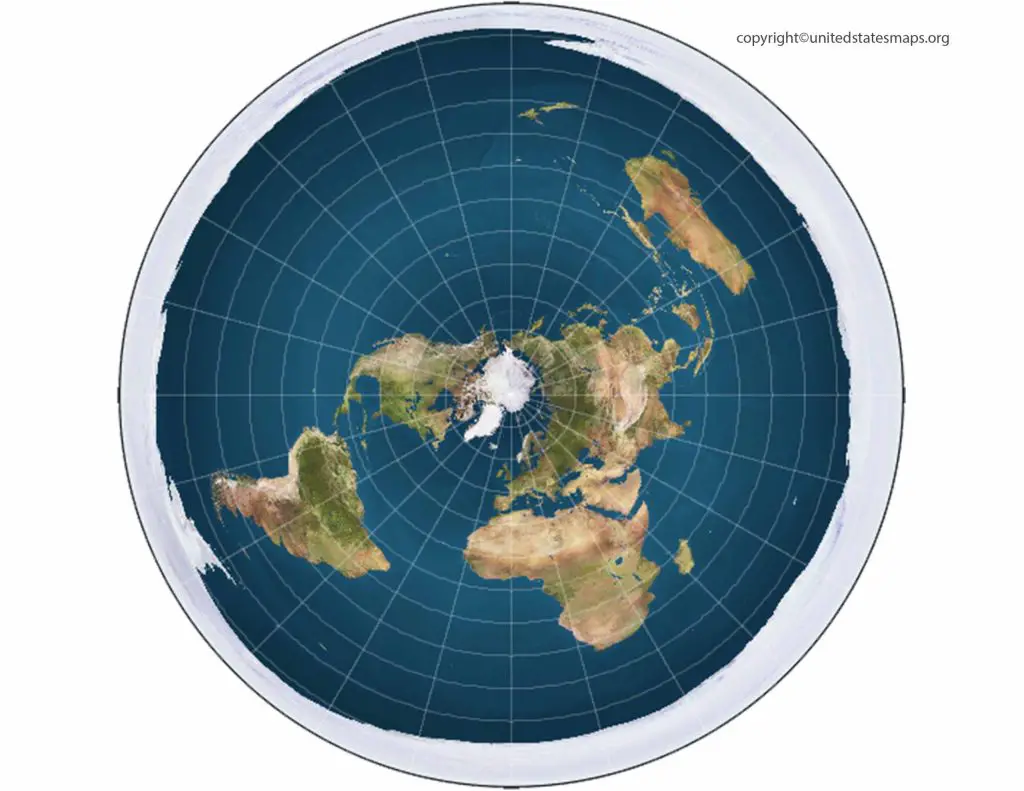
A Flat Earther Map is a visual depiction that aligns with the beliefs held by individuals who subscribe to the Flat Earth Theory. According to proponents of this theory, the Earth not a spherical planet but instead a flat disc. These maps aim to represent their unique perspective on the Earth’s shape and layout.
In a typical Flat Earther Map, the North Pole is positioned at the center, with the continents radiating outwards towards the edges. Some variations of the map may incorporate elements like concentric circles for latitude and longitude, attempting to provide a framework for navigation and orientation.
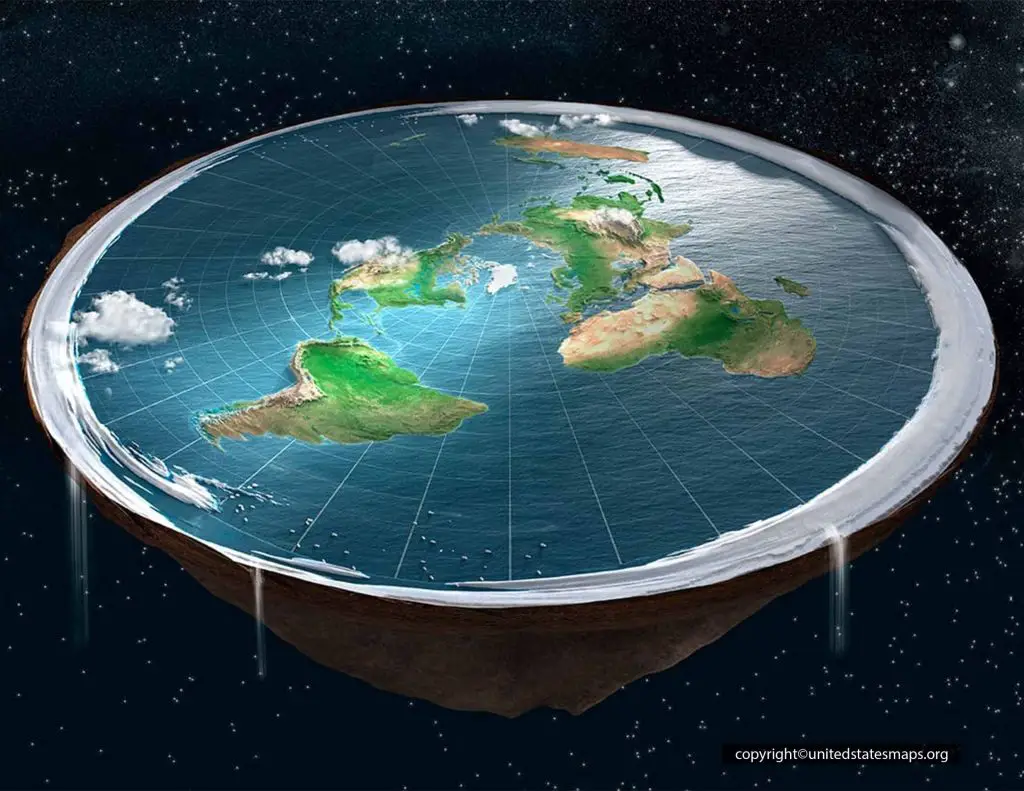
The mention of a “Flat Earth Map 1587” seems to imply a specific map related to the Flat Earth Theory that created or referenced in the year 1587. However, it is crucial to note that the Flat Earth Theory as we understand it today gained popularity much later, and the scientific consensus had already established the Earth’s spherical shape by that time.
Map of Earth Flattened
While proponents of the Flat Earth Theory argue for the existence of a Real Flat Earth Map, their claims lack scientific support and contradict vast amounts of evidence. Scientific experiments, observations, satellite imagery, and centuries of exploration have consistently demonstrated the Earth’s spherical shape.
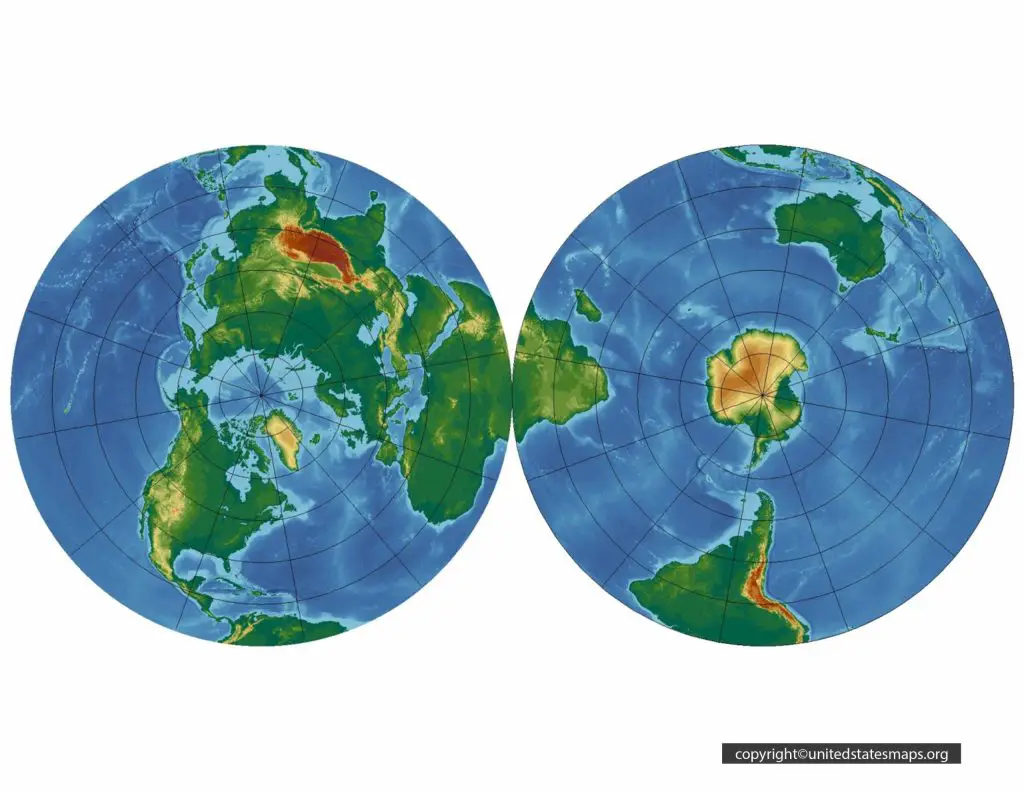
The concept of a Map of Earth Flattened refers to a representation of the Earth that has been altered to remove the curvature associated with its spherical shape. While the Earth indeed a spheroid, certain projections and maps attempt to approximate its features on a two-dimensional surface.
One example of a map projection that can considered a Map of Earth Flattened the Mercator projection. The Mercator projection a cylindrical map projection that distorts the size of objects as they move away from the equator, resulting in an exaggeration of landmasses near the poles. This projection provides a rectangular representation of the Earth, but it does not accurately depict the true sizes and shapes of continents and countries.
A Flat Earth Map is a map created according to the flat-Earth model, which is a belief that Earth is a flat plane rather than a roughly spherical planet. The most commonly shared version is the Azimuthal Equidistant projection, often presented with the North Pole at the center and Antarctica around the outer edge. It is important to distinguish this model from scientifically established maps: Earth is an oblate spheroid, and the flat-Earth model is not supported by modern scientific evidence.
🗺️ What Is a Flat Earth Map?
- A flat Earth map represents the world as a flat surface.
- Many versions place the North Pole at the center.
- Continents are arranged around the central North Pole.
- Antarctica is commonly depicted as a large circular boundary around the outside.
- Oceans are shown between the continents.
- Latitude and longitude are represented differently from how they appear on a globe.
- Some versions are based loosely on the Azimuthal Equidistant projection, although the projection itself is a legitimate cartographic technique and does not demonstrate that Earth is flat.
Keywords: flat Earth map, flat world map, flat Earth world map, flat Earth map of the world, world map flat Earth
🌎 Continents on a Flat Earth Map
A typical flat Earth world map includes the same seven continents found on conventional world maps:
- North America
- South America
- Europe
- Asia
- Africa
- Australia
- Antarctica
In flat-Earth representations, the arrangement and apparent distances between continents can differ substantially from conventional globe-based maps.
Secondary keywords: flat Earth continents map, flat world map continents, continents on flat Earth map, flat Earth geography
🧭 North Pole and South Pole
One of the most noticeable features of a flat Earth map is how the poles are represented.
- The North Pole is generally placed at the center.
- The continents spread outward from the central area.
- The South Pole is not normally represented as a single central point.
- Antarctica is often illustrated as an outer ring or boundary.
- This arrangement differs from a globe, where both poles are points on Earth’s rotational axis.
🌐 Latitude and Longitude
Latitude and longitude are essential for understanding world geography, but their appearance changes when spherical Earth coordinates are represented on a flat projection.
- Lines of longitude radiate outward from the North Pole in the common azimuthal representation.
- Lines of latitude form increasingly larger circles away from the center.
- The equator appears as a large circular line around the map.
- Locations near the center can appear less distorted than locations near the outer edge.
- Distance and direction can become increasingly distorted toward the edges of the projection.
LSI keywords: latitude and longitude map, world coordinates, geographic coordinates, flat Earth geography map
🧊 Antarctica on the Flat Earth Map
Antarctica is one of the most distinctive elements of many flat Earth maps.
- Antarctica is frequently shown as a circular landmass surrounding the other continents.
- It is sometimes described in flat-Earth models as an outer ice boundary.
- This representation is different from conventional maps, which show Antarctica as a continent surrounding the South Pole.
- Modern geographic and satellite observations show Antarctica as a continent located around the South Pole.
🌊 Oceans on a Flat Earth Map
A typical flat world map displays the major oceans surrounding the continents:
- Pacific Ocean
- Atlantic Ocean
- Indian Ocean
- Southern Ocean
- Arctic Ocean
The appearance and relative distances of these oceans vary considerably depending on the map projection.
🏙️ Countries and Major Cities
A detailed flat Earth map of the world may label hundreds of countries and cities.
Examples include:
- United States — Washington, D.C.
- Canada — Ottawa
- Mexico — Mexico City
- Brazil — Brasília
- United Kingdom — London
- France — Paris
- Germany — Berlin
- Egypt — Cairo
- India — New Delhi
- China — Beijing
- Japan — Tokyo
- Australia — Canberra
- South Africa — Pretoria
These are real geographic locations, although their relative positions and distances can appear distorted when displayed on a flat projection.
✈️ Air Routes and Distance
Flat-Earth maps are sometimes used online to illustrate arguments about airplane routes and distances.
- Users may compare routes between cities.
- Long-distance flights can be plotted on different map projections.
- A route that appears straight on one map may not represent the shortest path on a globe.
- On a spherical Earth, long-distance navigation commonly uses great-circle routes.
- Map projections can make distances and shapes appear different from their actual geographic relationships.
Secondary keywords: flat Earth flight routes, flat Earth distance map, airline routes map, world flight map
🛰️ Satellite and Space Maps
A flat Earth map is also frequently discussed in relation to satellite imagery and space-based observations.
- Modern satellite systems use measurements based on Earth’s spherical/ellipsoidal shape.
- GPS positioning depends on geodetic models of Earth.
- Weather satellites provide images of Earth from orbit.
- Space agencies and independent organizations use satellite observations to map Earth’s surface.
- These observations provide strong evidence that Earth is not a flat plane.
Flat Earth Map vs. Conventional World Map
| Feature | Flat Earth Representation | Conventional Earth Map |
|---|---|---|
| Earth shape | Flat-plane model | Spherical/ellipsoidal Earth |
| Common center | North Pole | Depends on projection |
| Antarctica | Often shown as outer ring | Shown as a continent |
| Longitude | Radiates from center in common model | Depends on projection |
| Distance | Can become highly distorted | Projection-dependent |
| Scientific model | Not scientifically accepted | Based on geodetic measurements |
| Common use | Alternative-model discussions | Geography, navigation, education |
Why Are Flat Earth Maps Popular?
- They are widely shared in online discussions about alternative models of Earth.
- They provide an interesting example of how map projections can change the visual appearance of geographic data.
- They are sometimes used in discussions about geography, navigation, travel distances, and astronomy.
- They can help students understand the difference between a map projection and the actual shape of Earth.
- They are also popular in graphic design, educational comparisons, documentaries, and internet culture.
Important Scientific Context
The Flat Earth theory is not accepted by modern science. Multiple independent observations—including satellite data, spaceflight, Earth’s measurable curvature, global navigation systems, lunar eclipses, and astronomical observations—are consistent with Earth being approximately spherical.
Therefore, a flat Earth map should be understood as a representation of a particular model or belief, not as an accurate geographic map of the physical shape of Earth.
It’s crucial to understand that while map projections like the Mercator useful for certain purposes, they not accurate representations of the Earth’s actual shape and proportions. To truly comprehend the Earth’s features, necessary to consider three-dimensional models or utilize alternative map projections that minimize distortion.